
Five Acrostics in Genesis 38 and the 6 equidistant letter spaced genealogy of David
E W Bullinger's work on the Acrostics in Esther is a choice jewel (archive). It illumines with glorious insights into the hidden depths of the whole inspired volume and dovetails beautifully both with the Hebrew sense of Esther's Persian name (I hide, Deut.32.20) and its theme, I note this subsequent observation.
Here's a particularly famous acrostic, left as a posthumous note, by Yitzhak Kaduri, which spelt Yehoshua, the full Hebrew name of Jesus the Messiah.


Acrostics of various kinds are common in scripture, Psalms 34 and 119, and Prov.30.10-31 being especially famous instances of an acrostic text, and Ps.96.11 of bearing the Divine Name, as a palindromic (double directional) acrostic,but there are many other, many incomplete.
Inevitably with researching acrostics, which are very popular among certain Hasidic Jews and a certain mathematical kind of Christian mind, one is forced also to consider the enthusiasm for equidistant lettering sequences (ELS). ELS are a different matter altogether however. They often require computers to find them, or great diligence with pen and paper to search. They have also spawned all sorts of dubious prophecies about the future, and unsound private interpretations, 2 Peter 1.20.
Like numerology as a whole, the ordinary believer is wise to be cautious, if not sceptical.
Scripture is deep work, the Divine Mind revealed, but the faith that it produces is not a mathematical proof of the Divine, to gratify the curious, but of faith in His character and faithfulness (Rom.10.6-10, John 11.26).
This is the kind of faith in God, in His promise and His character, rather than his mathematical precision, that is exceedingly precious to Him (Job.2.6; 23.10; 42.10, 1 Pet.1.7).
Of course, if your spouse was an accountant, and the household accounts weren't well kept, that would reflect poorly on his or her character, as well as professional competence.
Neverthless, there are some remarkable claims for ELS, here is one:
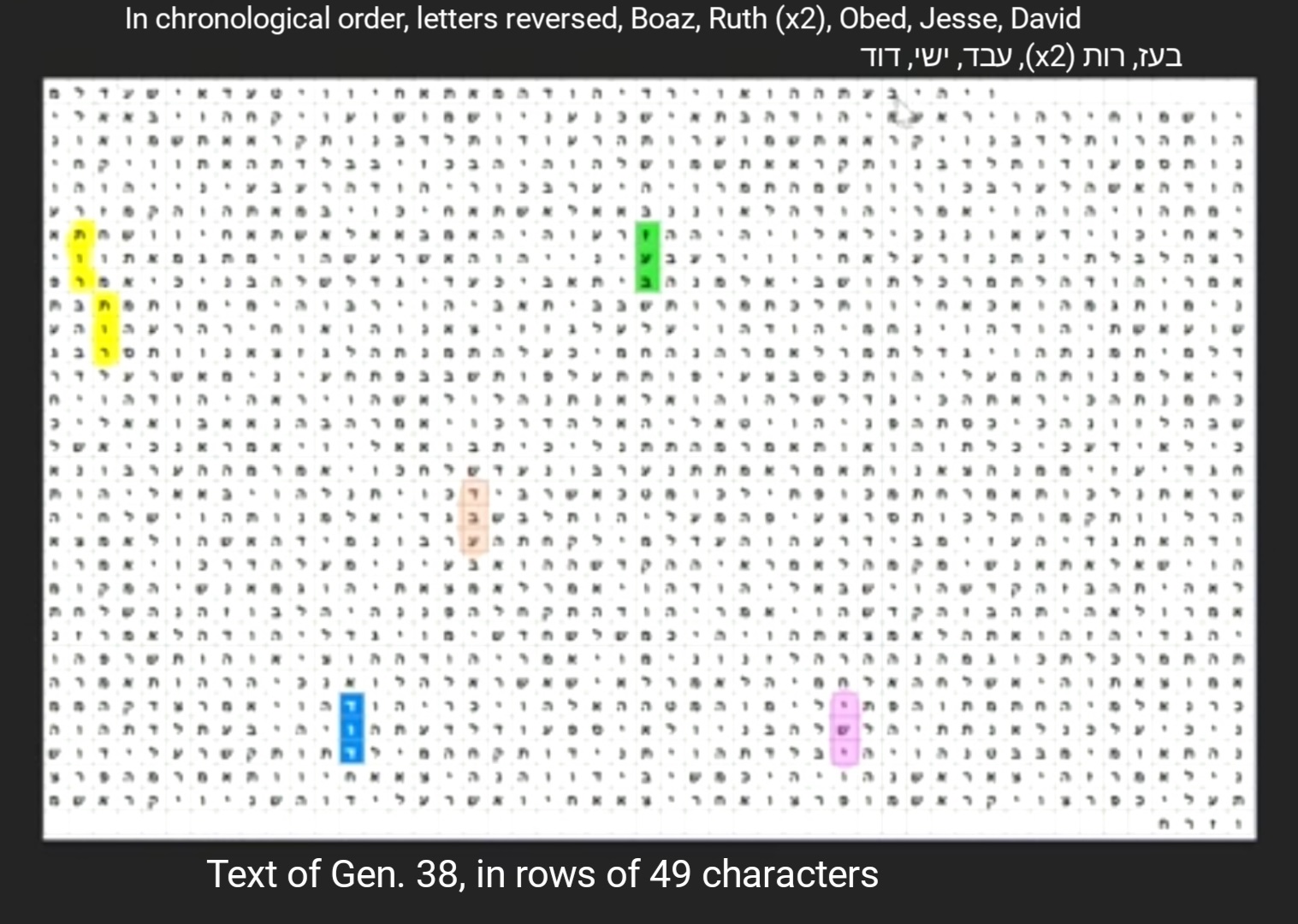
The unbelieving Jewish author of the image explains it well. In the only passage in Genesis that focuses on the genealogy of Judah, we have Boaz, Obed, Jesse, David and in the only passage that writes of a Gentile woman's suit for a child, we have Ruth (twice!), intertwined with the listing of her husband Boaz, the first letter of her name appears in the narrative, first just as Judah vacillates over Tamar's husband (v.11), and then as she chooses to act (v.14).
David and Jesse's names are also intertwined, (the first letter of the name overlaps with those of the other).
All 5 names are listed in chronological sequence, with exact distances of 49 characters between the letters of each name. A numerological brother will immediately point out that 49 is 7 x 7, and a pre-Jubilee number. In Hebrew, their names are short, all three letters, and Jesse and David are palindromic, but the statistical likelihood of this, whilst difficult to calculate, must be small.
Quibblers who claim that Obed must have four characters, forget Ruth 4.22, where his name is abbreviated to 3.
Each name is given in reverse, and interwoven with these hidden ancestral names, are no less than 5 acrostics in this one chapter alone, 2 for the Sacred Name YHVH, יהוה, and 3 for the linking Divine Name, AHVH, אהוה, we have considered before in Esther, which links AHIEH, אֶהְיֶה, with יהוה.
Here are the two findings side by side, the placement of the acrostics in the first or last letters, and the 6 ELS names, to show their relative placement in the text (in the spreadsheet, the Hebrew words occur R-L).
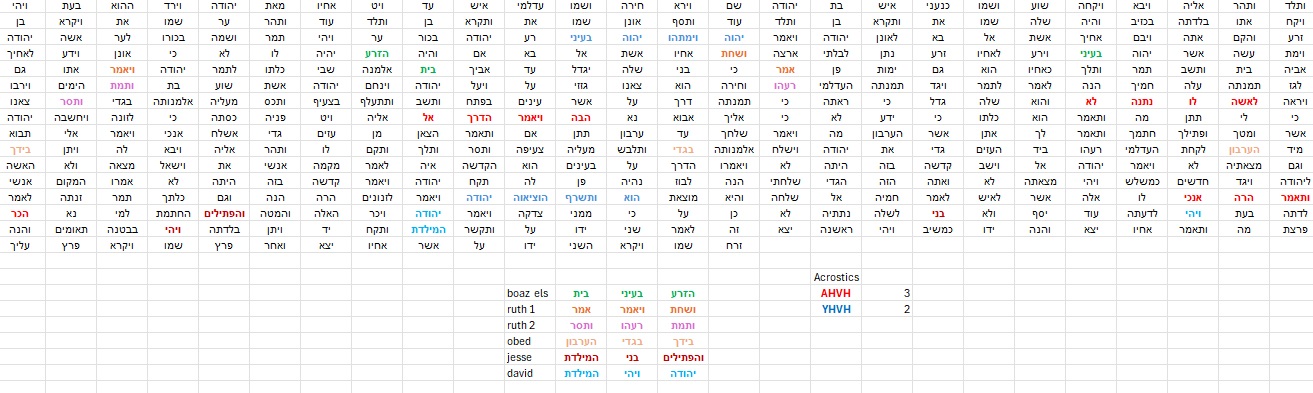
The comparison with Esther's acrostics for both YHVH and AHVH is instructive.
All five acrostics are in the direction of of the text.
Of the two YHVH acrostics, the first occurs in the last letters of each word, the second in the first.
1. בְּעֵינֵי יְהוָה; וַיְמִתֵהוּ, יְהוָה Gen.38.7 at the judicial death of Er. 'wicked in the sight of the LORD; and the LORD slew him.'
בעיני יהוה ימתהוו יהוה
2. יְהוּדָה, הוֹצִיאוּהָ וְתִשָּׂרֵף .הִוא Gen.38.23-4 "Judah said: 'Bring her forth, and let her be burnt.' She..."
יְהוּדָה הוֹצִיאוּהָ וְתִשָּׂרֵף הִוא
As with the YHVH acrostics in Esther, the direct actions of the Lord are highlighted by being in the direction of the text. In the case of Er's death, in a hidden manner, in the case of Judah's hypocritical judgement being pronounced before his exposure in an open and public way.
The three AHVH acrostics are again, in sharp contrast to Esther, all in the direction of the text, but the first occurs in the last letters, which is unusual and more unlikely by around 23 times, the second two occur in the first.
1. לֹא-נִתְּנָה לוֹ לְאִשָּׁה Gen.38.14 (a last letter acrostic, which is c.23x less likely by chance) Tamar not given as wife. 'she was not given unto him to wife.'
לֹא נִתְּנָה לוֹ לְאִשָּׁה
2. אֶל-הַדֶּרֶךְ, וַיֹּאמֶר הָבָה Gen.38.15 "he turned unto her by the way, and said: 'Come, I pray thee'"
אֶל הַדֶּרֶךְ וַיֹּאמֶר הָבָה
3. אָנֹכִי הָרָה; וַתֹּאמֶר, הַכֶּר Gen.38.25 Conception. "...am I with child'; and she said: 'Discern'"
אָאָנֹכִי הָרָה וַתֹּאמֶר הַכֶּר
Both Boaz and Ruth's names are closely linked to the text, and the first YHVH before and first two AHVH acrostics after envelope them quite tightly, but without overlap.
Some parallels between Ruth and Tamar are obvious, both are outsiders and Gentiles, like Rahab, who also shares their mention in Matthew's genealogy. They are both childless, till this promised union. Ruth uncovers her head, at Boaz's request, Tamar covers it to gain her end.
Ruth 4 is the next chapter in the Bible after Gen.38 to include Obed and the genealogical list explicitly. This chapter of Ruth directly refers to and blesses Tamar, Ruth 4.12, who is herself not elsewhere mentioned in the Bible, except in 1 Chr.2.14 and Matt.1.3.
Both passages have a strong emphasis on marriage, death, widowhood, the challenges of remarriage and conception.
-Boaz
1st letter: go to home of your father v. 11
2nd letter: The Eye of Lord v. 10
3rd letter: The seed v. 9
-Ruth 1st occurrence
1st letter: Judah says lest he die v. 11
2nd letter: And Judah Says v. 10
3rd letter: Wasted seed on ground v. 9
-Ruth 2
1st letter: Tamar removes (tsR) her clothes of widowhood v. 14
2nd letter: beginning of verse, His friend v. 13
3rd letter: Died daughter of Shua v. 12
Obed's name occurs in isolation, and indeed his life is little known.
-Obed
1st letter: missing surety price for conception v. 20
2nd letter: Clothes of widow hood again v. 19
3rd letter: Staff in your hand v. 18
The last two acrostics, first the judgement of Judah,
YHVH, then the gentle, but excruciating counter challenge of Tamar, AHVH, both precede the last two names.
-Jesse
beginning of birthing v. 28
to Shelah my son v. 27
Cord v. 26
-David
midwife ties hand of twin v. 28
Did not again know her v. 27
Discerns JuDah v. 26
Jesse and David's names are closely intertwined with the birth of Tamar's twins.
Linking of the textual significance of two quite different methods of highlighting hidden meanings in characters provides mutual corroboration, if not perfect vindication for both.
However if an mathematically minded brother in the 10 strong Beth Din at Bethlehem, affirming Boaz's decision, later carefully surveyed the book of Genesis, whilst he might find Boaz and Ruth mysteriously intertwined in the earlier reference, he would almost certainly not predict Obed, David or Jesse's names from the text. ELS here is only useful in retrospect, to emphasise and signpost what is already revealed, not to predict.
Message on Tamar and the Lord of pure light, dwelling in and overruling the darkness of human devices.
The Divine Name.
Semiarian translations of John 8.58.