(Much of the contents of this
article are sensitive and are not suitable for children)
Islam is usually considered superficially by Western minds as a
puritanical faith set on ascetic practices like fasting, the
strict segregation of women, and an excessive regard to female modesty.
Indeed in some respects, Muslims are to be commended for their emphasis
on family life, the sanctity of marriage, the modesty of female attire,
the censorship of sexual impurity, and some judicial punishments for
sexual offenses (Job. 31.11). Despite many
serious and iniquitous abuses and a foul tendency to denigrate
women (very evident in some Hadith
literature), in some of these respects they
represent a distorted reflection of scriptural requirements, ones which
many foolish and forgetful Jews and Christians have neglected to their
own eternal harm.
والحياء شعبة من الإيمان -
modesty is a branch of faith (Bukhari, 1.2.8).
However this assessment neglects an important aspect of Islam. Like the
fertility cults from which it draws some root, Islam contains a
prominent and profoundly improper focus on the physical aspects of
sexuality in its worship.
Our sexuality is a uniquely sacred Divine gift, mysteriously reflects
the Divine image and essence (Gen.
5.1-2) and is one of the highest blessings given to mankind. It is
sanctified and blessed within the covenant of matrimony and both defiled
and accursed without it. The sacred scriptures
abominate the error that sexual intercourse is in and of itself evil, in
its lawful context (Prov.
5.19 inter alia). Sexual perversion is a direct result of Divine
judgement for unbelief, and is not only an apt response, but bears
mysterious parallel to creature worship (Romans.
1.24-28, esp v.27, 'a meet recompence').
Nevertheless, in spite its virtuous veneer and some real restraints and
benefits, Islam emphasises sexuality in a manner that deeply derogates
from its lawful place and function as the following short list
demonstrates.

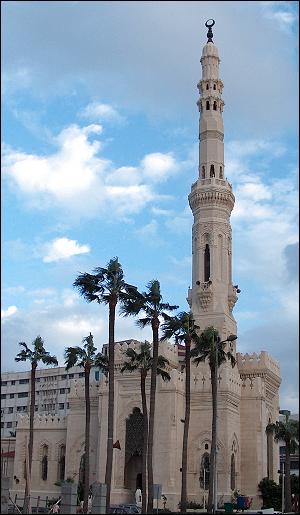
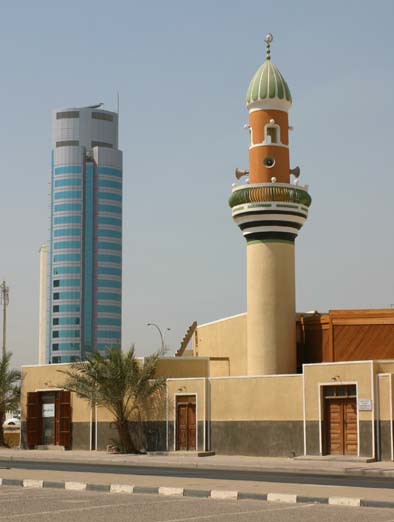
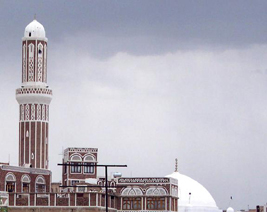
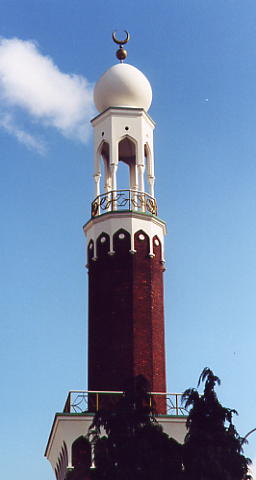
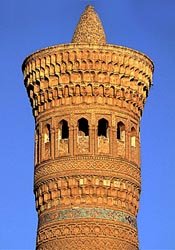
- An abundance of phallic symbols in places of worship - some
apparently neatly circumcised. (Just a very small sample below).



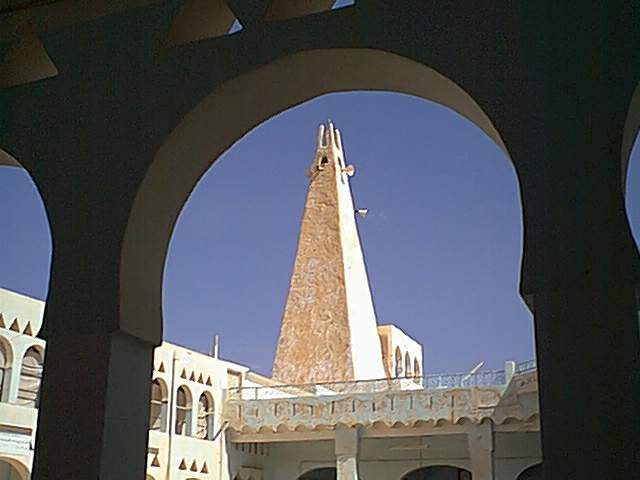

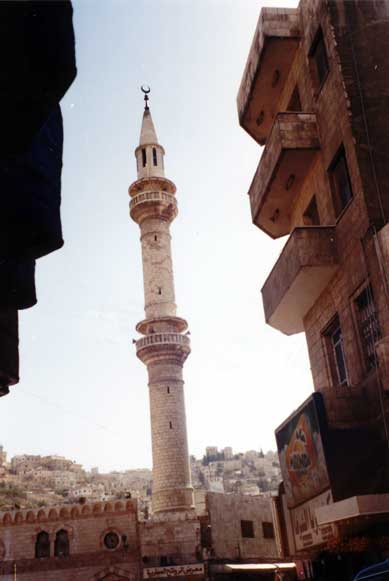


 The
latter image from here
The
latter image from here
- Can you imagine any other group using a symbol like this
without embarassment?
- The virtual invisibility of women in most mosques at times
of congregational prayer.
- The repetitive focus on fertility in calls to prayer ('Haya
‘Alel Falah')
- In the chosen colour of Islam green, a symbol of
fertility.
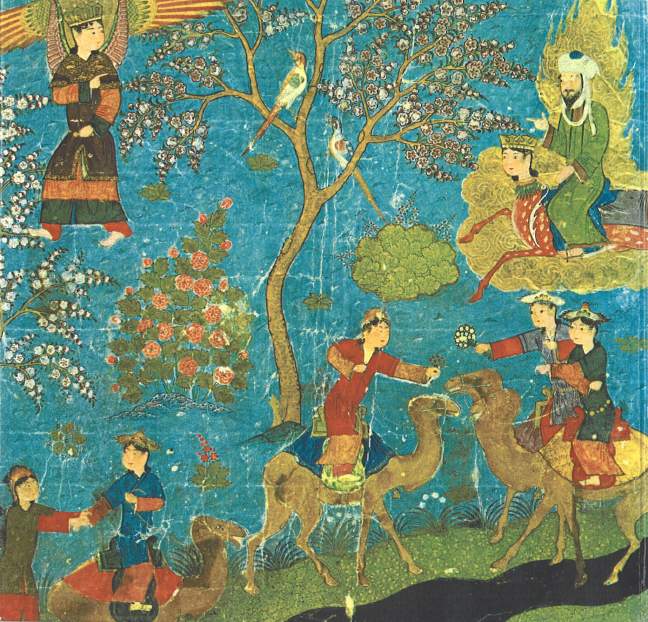
The
Muslim
prophet depicted (by Muslim artists) all in green, riding the female Buraq, top right
(Miraj
Nama,
which is in the Bibliotheque Nationale)
- In its intense focus on the lunar cycle for its calendar and
the ubiquity of lunar symbols (lunar-based
faiths often denote a connexion with the female menstrual
cycle). Unlike the Jewish or Chinese lunar calender, the Islamic
year strictly follows the moon with no intercalary months and thus
falls out of synchronisation with the seasons and the solar year.
This idolatrous
 reverence is further evidenced by the superstitious
regard paid by Muslims to times of solar or lunar eclipse,
and the extraordinary panic the author witnessed in their ranks at
such times in the Middle East in 1999. (The ceremonies which take
place at the eclipse (Salat-al-Kusuf) require: 2 rak’at with up to
three of four ruku’ each, and 4 recitations, at the time of though
not necessarily for the whole duration of the eclipse, though
Mohammed did pray and recite all the way through the solar eclipse
on the day of his son's death, one suspects he was influenced by
pagan Arab tradition before.)
reverence is further evidenced by the superstitious
regard paid by Muslims to times of solar or lunar eclipse,
and the extraordinary panic the author witnessed in their ranks at
such times in the Middle East in 1999. (The ceremonies which take
place at the eclipse (Salat-al-Kusuf) require: 2 rak’at with up to
three of four ruku’ each, and 4 recitations, at the time of though
not necessarily for the whole duration of the eclipse, though
Mohammed did pray and recite all the way through the solar eclipse
on the day of his son's death, one suspects he was influenced by
pagan Arab tradition before.)
Image
taken from here.
- The peculiar prohibition on women praying during
menstruation
- even domestic ritual prayers must
cease - a position unique to Islam.
The
preferred titles of Deity
- The opening words of every sura but one (the ninth) in the
Qur'an are 'In the Name of the God, merciful, the
compassionate',
'بِسْمِ اللّهِ
الرَّحْمـَنِ الرَّحِيم'. Both these
attributes (rahman and rahim) are cognates of the arabic for the
womb denoting the tenderest and most sensitive feelings of sympathy
(rahm, رحم).
This is a common theme with Christianity and Judaism, according to
Hitti, there are ancient stone inscriptions in Arabia antedating
Islam which have been attributed the use of very similar expressions
to Christian Arabs.
The
Niqab
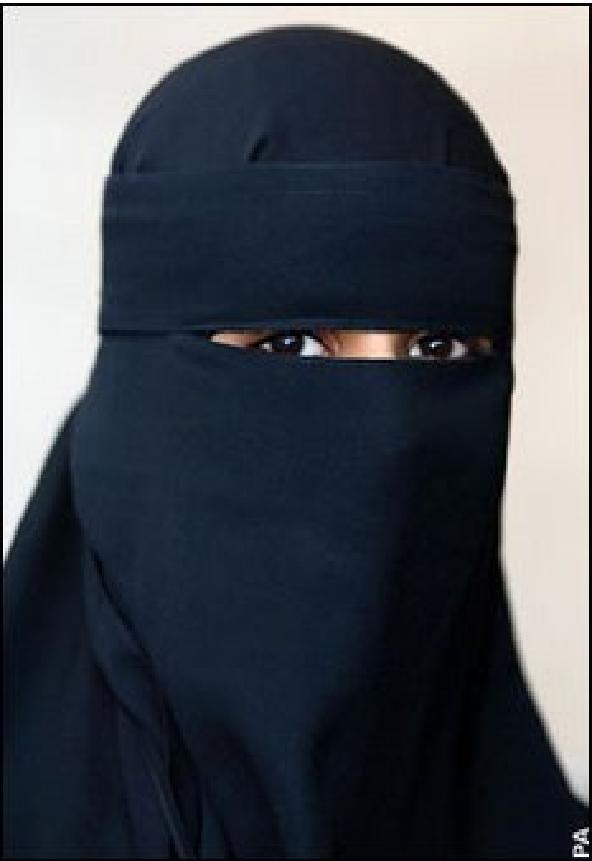
- One striking aspect of the heightened focus on sexuality in
Islam is the veiled concealment of the female face by the Niqab or
the Burqah. In Middle Eastern practice traditionally, the use of a
face veil, has often been reserved for enhancing sexual attraction
before marriage. A gentle primary example is found in
the Torah's account of Rebecca (Gen.
24). When Abraham's servant first meets the young virgin, goes
to her house, discusses her marriage with her family and then
travels back with her there is no
mention of a veil. On the contrary, she is described as 'very fair
to look upon' (v.
16). When she travels to a foreign country, in a party of
strange men, it is not until she
is told that the man coming to meet her is her husband to be, that then and then
only she takes and wears the veil. The attractiveness and
allure of the face veil is well illustrated below:
Or this use of the Niqab (and Hijab) for enticing pictures in a
'matrimonial service' ad, which may be associated with trafficking.
- There is also a hint of the use of such a veil in some
marriage ceremonies, in Laban's ensnaring his nephew Jacob in
wedlock not to his beloved Rachel, but to Leah (Gen.
29.18-25). Even if Jacob had been inebriated it is difficult
to see how he might not have discovered the true identity of his
bride till the morning unless her face was covered.
- 'Taking the veil' in Tamar's case in Genesis
38 v.14 however had an altogether more sinister sense than
today. She sought to beguile her father in law to provide directly
that which he was duty bound to provide in the person of his third
son, namely an heir. His sinful reluctance lead him to exclaim later
that, 'She has been more righteous than I', when he discovered how
she had conceived by deceit.
- The indiscriminate, public use of a face veil was a
characteristic not of modesty, but of the precise opposite. It was
devotees to pagan cults, who usually served as prostitutes, who wore
such clothing to heighten their attractiveness to clients. This is
unmistakeable in Genesis
38.15-18. 'When Judah saw her, he
thought her to be an harlot; because she had covered her face'. He
knew no other practice, and of course was familiar not only with
Canaan and Syria, but also had some knowledge of Egypt and
Mesopotamia from his father and grandfather. Tamar left
her
widow's clothes to take the veil, and forsook the veil to take them
up again once her mission was complete - indicating how profoundly
improper such clothing was for a godly widow, in the Middle East of
the time.
- The word used for 'harlot' or prostitute here in v.20, but
not v.15 which uses the more standard word for an adulteress, is the
word 'Qadosha' - which is the feminine form of the word
'sanctified', or set apart, and indicates that the wearer was
devoted to a temple for the most profane and ugly sin. In Hosea
4.6-17, for example, the same word (v.14) is used of the
harlotry associated with
pagan
idolatry. The law places strict prohibitions on both sexes engaging
in such practice, and the words translated for prostitution are both
derived from the temple word 'Qadosh', Deuteronomy
23.17, in case of doubt the very next verse clarifies the
meaning of the preceding terms and brands it an 'abomination'.
- Although many terms are used for veil in the Tenach/Old
Testament, the word used in Genesis 24 and 34 explicitly
for a face veil (tsa‘iyph) is found only in
these two places (three times). It is derived from the
verb 'to fold', distinguishing it from other veils and head
coverings which did not need to be folded around the eyes. If only
Muslims were better aware of the roots of their traditions and of
the real heart intentions behind them, promiscuous use of the Niqab
would not be seen as a paragon of virtue, but as an encouragement to
vice.
- The Babylonian Talmud, compiled c 500 AD, alludes to the pre-Islamic practice of face veiling amongst the Arab women (65a Sabbath Tractate)
- "The word, niqaab (sing.) (نقاب)
and nuqub (pl.) in its Arabic root naqaba (نقب )
means to bore, to pierce, to make a hole. As a reforming Muslim
writer explains 'the sexual nature of the root should be
apparent. In Hebrew and Aramaic the same root meaning exists.' In
Hebrew the word NeKeV (bqn),
which means 'hole or perforation' and the word for 'female',
NiKVah (hbqn)
comes from this root.
- There is contemporary evidence of an identical use of the
Niqab in Cairo, in BBC
correspondent
Christian Fraser's report, 10/10/09, 'There are shops doing a
roaring trade in garish fishnet stockings, clothes that belong to a
budget production of the film Moulin Rouge, alongside those selling
the all-enveloping outfits more commonly seen in this increasingly
conservative society. It is, though, whispered in shadowy corners of
this city that prostitutes are in fact customers at both types of
shop.' It is at all not surprising that both
forms of unclean hypersexualisation, Western and Middle Eastern, sit
side by side. A German perfume manufacturer has also exploited the
heightened sexual sensitisation involved in the use of the Niqab, as
much as the wearing of other salacious clothing, in a lewd video
unfit for display here. Some Muslim forum
posters have rather slowly begun to wake up to its
hypersexualising effects too.
- Recently the use of the Burka and Niqab has also taken hold
in the Jewish Haredi communities in Beit
Shemesh (original
Hebrew
report) and elsewhere, apparently following a Jewish female
"rabbi's" lead. The vigorously anti-Zionistic Naturei
Karta ultra Orthodox rabbis and other rabbis have banned it on
the grounds of its untoward effects on sexual dynamics. As reported
in JC, 'The Eda
Charedit is very against it and sees in it a real danger that by
exaggerating you are doing the opposite of what is intended - severe
transgressions in sexual matters.'
It is a great tragedy that Islam has foolishly and cruelly
mistaught its young women that what has long before been designed to enhance lust is somehow instead a
remedy for it, and it is a significant root of hidden vice and abuse in
Muslim societies.
Heightened level of sexual assault at Eid Al Fitr
See this wikipedia page for documentation of a perennial problem. Edward Lane also indicates debauchery
was a regular occurrence around the festival in his day, 'Intrigues are
said to be not uncommon with the females who spend the night in tents
among the tombs'. (Modern Egyptians, vol.2. p.238, cited in Hughes, T.P., Dict. of Islam)
Islamic State has a highly developed theology of sacralised rape: 'He said that by raping me, he is drawing closer to God'; Rape "is 'Ibadah" (عبادة). 'Having sex with her [a 12 yr old captive] pleases God'
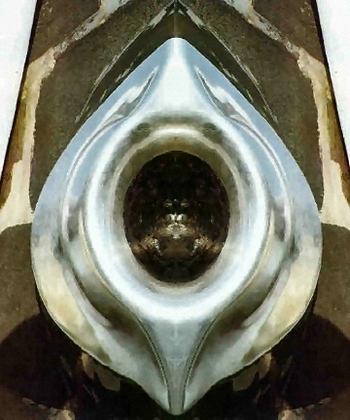
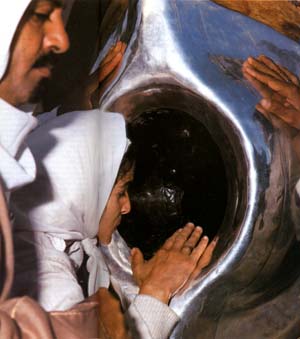
The Ka'bah
But the most shocking aspect of Islam's focus on
sexuality and the evidence for its rootedness in fertility rites has
long been recognised to focus in the
Ka'bah
itself.
- The Ka'bah itself was addressed as a female Deity in
pre-Islamic times, as this short section from Ibn Ishaq's biography
shows,
'The
the
people were afraid to demolish the temple, and withdrew in awe from
it. Al-Walid b. al-Mughira said, 'I will begin the demolition.' So
he took a pick-axe, went up to it saying thewhile, 'O God, do not be
afraid2 (132), O God, we intend only what is best.' Then he demolished the part at the two corners.'
2 The
feminine form indicates that the Ka'ba itself is addressed. (Ibn
Ishaq's Sirat ar-Rasul, Pt .1.124., translated by Alfred Guillaume,
published OUP Pakistan.)
- In the lewdity of the older
Egyptian
rites of marriage, described by Lane#, in which two
rak'ahs or prayer cycles are performed by the bridegroom toward his
naked bride's sexuality, whilst she is orientated in the direction
of the Ka'bah, as though she herself was the representative of the
object prayed to. This local interpretation of Islamic practice is
especially significant, since Egyptian Muslims are usually just as
scrupulous as others that persons, especially
women, do not intervene their line of sight with the mithrab - the
indicator of the direction of Mecca.

#Here cited by T.P.Hughes. Dict. of Islam.
There is some evidence Mohammed also followed the
same procedure with Ayesha - 'Narrated 'Aisha: Do you make us (women)
equal to dogs and donkeys? While I used to lie in my bed, the Prophet
would come and pray facing the middle of the bed. I used to consider
it not good to stand in front of him in his prayers. So I used to slip
away slowly and quietly from the foot of the bed till I got out of my
guilt.' Why else would he direct his prayers toward the middle of her
bed? Bukhari
.1: 486 (cf. Sahih Bukhari 1.490, Sahih
Bukhari 1.493, Sahih Bukhari 1.498)
Nor is it surprising that during both pre- and post-Hijra
times, many worshippers,
both male and female, were compelled to circumambulate the rock
naked - revealing its potent, longstanding association with
fertility rites. (Ibid. 1.128).
According to Ibn Ishaq, it was not until 9 years after the Hijra that Muslims finally banned the practice (Sirat ar-Rasul 922).
It is likely that Surah 7.26-7 was revealed to stop Muslim emulation of this nakedness at the Kaaba.
يَا
بَنِي آدَمَ لَا يَفْتِنَنَّكُمُ الشَّيْطَانُ كَمَا أَخْرَجَ أَبَوَيْكُم
مِّنَ الْجَنَّةِ يَنزِعُ عَنْهُمَا لِبَاسَهُمَا لِيُرِيَهُمَا
سَوْآتِهِمَا ۗ إِنَّهُ يَرَاكُمْ هُوَ وَقَبِيلُهُ مِنْ حَيْثُ لَا
تَرَوْنَهُمْ ۗ إِنَّا جَعَلْنَا الشَّيَاطِينَ أَوْلِيَاءَ لِلَّذِينَ
لَا يُؤْمِنُونَ وَإِذَا فَعَلُوا فَاحِشَةً قَالُوا وَجَدْنَا عَلَيْهَا
آبَاءَنَا وَاللَّهُ أَمَرَنَا بِهَا ۗ قُلْ إِنَّ اللَّهَ لَا يَأْمُرُ
بِالْفَحْشَاءِ ۖ أَتَقُولُونَ عَلَى اللَّهِ مَا لَا تَعْلَمُونَ
O ye Children of Adam! Let not Satan seduce you,
in the same manner as He got your parents out of the Garden, stripping
them of their raiment, to expose their shame: for he and his tribe
watch you from a position where ye cannot see them: We made the evil
ones friends (only) to those without faith. When they do aught that is
shameful, they say: "We found our fathers doing so"; and "Allah
commanded us thus": Say: "Nay, Allah never commands what is shameful:
do ye say of Allah what ye know not?"
Even
today, Muslims avoid wearing stitched underclothing under the Ihram, the
grave cloth like coverings worn during the circumambulation of the
holy stone.
It may also account for the frequent sexual abuse experienced at this unholy site.
Joint worship of the Ka'bah by both polytheists and muslims is
confirmed by Bokhari (Book
23,
1021 et al), probably on another highly singular occasion
when an early version of Sura An-Najm was recited.
Perhaps it hearkens back to Ishmael's prolonged
submission to his divorced Egyptian mother, Hagar. A resonance which
the orphaned prophet must also have known in his own life.
This focus on the fertility cult is all the more extraordinary and
paradoxical given the Greek philosophical
anti-anthropomorphism inherent in Islam's doctrine of the sterile
nature of God.
It is blasphemously removed from the true character of the sacred
Name, who forged man male and female to express the Divine image (Gen
5.1-2). 'In
the thing wherein they dealt proudly he was above them.'
'Turning the grace of our God into lasciviousness, and denying the
only Lord God, and our Lord Jesus Christ.'
Jude 4.
Ibn Arabi, the famous Sufi mystic, wrote 8 love poems addressed to the Ka'aba, in a piece called the Taj ar-Rasa'il and wa-Minhâj al-Wasâ’il, The Crown of Epistles and the Path to Intercessions. It is replete with mystical imagery and symbolism. However the fact remains he addresses the Ka'aba as a personal intermediary to God and as female.
A sympathetic commentator summarises:
'What, moreover, is the meaning of the amorous relationship between the Shaykh al-Akbar Muhyiddin Ibn Arabi and this seductive, threatening, feminine mineral being, which appears before him in this way in the coolness of a moonlit night?'
The poetry becomes quite erotic and I won't repeat it here.